Choosing an OEM or ODM partner shapes your display product roadmap, cash needs, and launch calendar. The decision affects optical performance, touch integration, firmware, tooling, certification, and support. This guide compares each display brand collaboration model for your team and market.
What Do OEM and ODM Mean for a Display Brand?
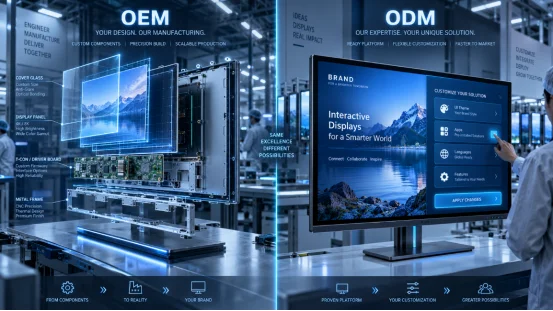
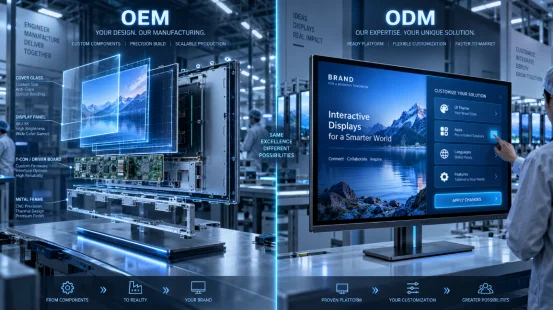
OEM and ODM describe who owns the product definition and engineering work. A contract manufacturer (CM) builds to your released drawings and process instructions. An OEM manufacturer produces your specified display, while an ODM partner contributes a platform or new design that you can brand and configure.
OEM: Your Design, Their Production System
With display OEM manufacturing, you provide industrial design, electrical architecture, panel choice, touch stack, software requirements, and acceptance criteria. The supplier turns those inputs into sourcing, assembly, testing, and packing. This route suits a team with product engineers and a defined user experience.
You control the bill of materials and revision history. You also carry early work such as prototype builds, tooling decisions, regulatory files, and failure analysis. A detailed statement of work keeps ownership clear when a component reaches end of life.
ODM: A Platform You Configure and Brand
Display ODM services start with a supplier platform, reference design, or proven module. You choose screen size, brightness, touch method, enclosure, ports, operating system, and cosmetic details for private label displays. Custom display development can add your logo, connector changes, mounting points, or firmware behavior.
An ODM shortens the path to a pilot order because the panel, backlight, and core electronics already have test data. Confirm which files, firmware layers, and tooling belong to you, and ask how exclusive the design is.
How Do OEM and ODM Change Time to Market?
Your launch date depends on design maturity, sample turns, certification, and component availability. Compare those work packages side by side with the supplier’s stated lead time.
Project Milestones to Track
Ask for dates covering requirements freeze, design review, verification, validation, pilot build, and mass production. Include display certification for electrical safety, EMC, environmental limits, and radio functions when needed. The supplier should name each action owner and the event that starts production.
Sample Rounds and Change Control
OEM projects often need more sample rounds because the design starts from your files. ODM projects may reach a pilot sooner, yet custom changes can trigger tooling or firmware validation. Set written change control with revision codes, approvals, and an obsolete-part rule.
Which Cost Drivers Matter in Each Model?
The right comparison includes one-time engineering and recurring unit cost. Build a simple model for your forecast volume, minimum order quantity, warranty rate, and inventory risk.
Tooling, NRE, and Unit Price
OEM work can include enclosure molds, brackets, optical films, and test fixtures created for your design. These items add display tooling cost before the first sale. ODM work spreads platform tooling across several customers, while your custom changes may add smaller non-recurring engineering (NRE) charges. Request a line-item quote that separates tooling, engineering, samples, certification, packaging, and freight.
Minimum Order Quantity and Cash Flow
Ask how the minimum order quantity (MOQ) changes with panel size, memory, and custom parts. A lower MOQ can carry a higher unit price but reduce cash tied up in stock. For a new brand, compare the cost of a small pilot, an unsold batch, and a second production run. The cheapest unit price rarely answers that full cash-flow question.
How Does Product Ownership Affect Your Roadmap?
Ownership determines how you add features, move production, and support a product. Put the answer in the contract before development.
IP, Firmware, and Tool Ownership
For OEM, you own drawings, firmware, and custom tooling when the agreement says so. In ODM, the supplier may retain the base design while granting a usage license. Define access to source code, calibration data, test scripts, CAD files, and approved vendors, plus a transfer process if the relationship ends.
Component Changes and Supply Continuity
Display supply chain risk often comes from panels, driver ICs, LEDs, and touch controllers. Ask for an approved alternative list and notice period. Require fit, function, and reliability checks before a substitute reaches production. A shared end-of-life process gives time for a last buy or revision.
What Quality Controls Should You Require?
Display quality control needs measurable limits at incoming inspection, assembly, and final test. Your specification should cover luminance, color uniformity, dead pixels, touch accuracy, viewing angle, connector retention, and burn-in time.
OEM Quality Gates
Provide golden samples, test methods, and defect classes. Require first-article reports, optical data, and traceability by panel lot and assembly date. Process audits verify adhesive curing, cable routing, and ESD controls.
ODM Quality Gates
Start with the platform’s reliability data, then test each custom change. Check thermal behavior after enclosure changes, touch performance with your cover glass, and firmware recovery before the pilot. Keep an approval sample for each revision.
Which Model Fits Your Team and Market?
Choose OEM when your product experience, industrial design, or protected IP drives demand and your team can manage engineering ownership. Choose ODM when you need a tested platform, a shorter development cycle, and a defined set of configurable options. A hybrid path also works: start with an ODM module, then fund an OEM redesign after sales data confirms the feature set.
Score each option on roadmap control, launch timing, display tooling cost, MOQ and cash exposure, and transfer rights. Review the score with engineering, finance, and support to surface overlooked details.
How Can a Manufacturing Partner Support the Chosen Model?
The partner you select should match its process to your ownership plan. YIAISIGN presents its display product range for teams that need configurable display assemblies, and its company site provides a point of contact for project scoping. In an OEM engagement, ask for drawing review, sample control, test fixtures, and revision traceability.
In an ODM engagement, ask which modules are proven, which options are configurable, and how custom tooling and firmware are handled. A short technical workshop can map your target screen, touch stack, enclosure, certification, and forecast to a realistic pilot plan. That conversation keeps the collaboration model tied to the product decisions that matter to your customers.
FAQ
Q1: Is OEM or ODM better for a new display brand?
A: ODM fits a team that needs a tested platform and a shorter development path. OEM fits a team with a defined design and engineering resources to own the product.
Q2: Can you switch from ODM to OEM later?
A: Yes. Plan the transition by securing CAD files, firmware access, tooling rights, test methods, and approved vendor data in the initial agreement.
Q3: What should a display OEM quote include?
A: Request engineering scope, panel and electronics bill of materials, tooling, samples, certification, test fixtures, packaging, MOQ, unit price, lead time, and change-control terms.
Q4: How do you protect quality in an ODM project?
A: Approve a reference sample, define optical and touch limits, test every custom change, and link each shipment to a revision and panel lot.
Q5: Which model gives the lowest display tooling cost?
A: ODM often shares base-platform tooling across customers. OEM tooling cost depends on enclosure complexity, optical parts, fixtures, and the ownership terms in your project.