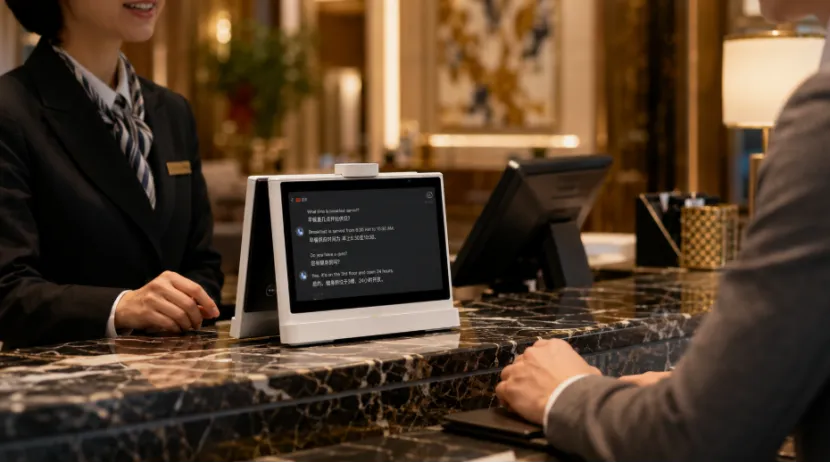
Hotel front desks deal with language problems every day. A guest arrives tired after a late flight. The booking name is slightly different. The deposit rule needs explaining. Breakfast ends at 10:00, but the guest hears 11:00. Small things, yes, but small things become bad reviews fast.
That is why a hotel front desk translator is moving from “nice to have” to practical daily equipment. A dual-screen AI translator gives both staff and guests a clearer way to talk, read, confirm, and move on.
Why Do Hotel Front Desks Need Better Translation Tools?
Hotel reception is not casual chat. It includes money, ID checks, room rules, time limits, and guest requests. When hotel guest communication is unclear, staff spend more time repeating the same point, and guests feel unsure.
Hotel Policies Often Create Misunderstandings
Deposit rules, smoking policy, breakfast time, check-out time, and extra charge translation are common trouble spots. These are not fancy topics, but they must be clear. A guest may accept a fee when it is explained well. They may argue when they feel it came as a surprise.
Staff Language Ability Is Not Always Stable
You may have one strong English-speaking employee on the morning shift and a new employee at night. That happens in real hotels. An AI translator for hotel reception helps front desk staff language support stay more consistent across different shifts, weekends, and busy seasons.
What Makes a Dual-Screen AI Translator Different From a Mobile Translation App?
A mobile translation app can help in an emergency. But at a hotel counter, it often feels temporary. The screen is small, the phone has to move back and forth, and some guests do not like speaking toward a staff member’s personal device.
Two Screens Let Both Sides Read at the Same Time
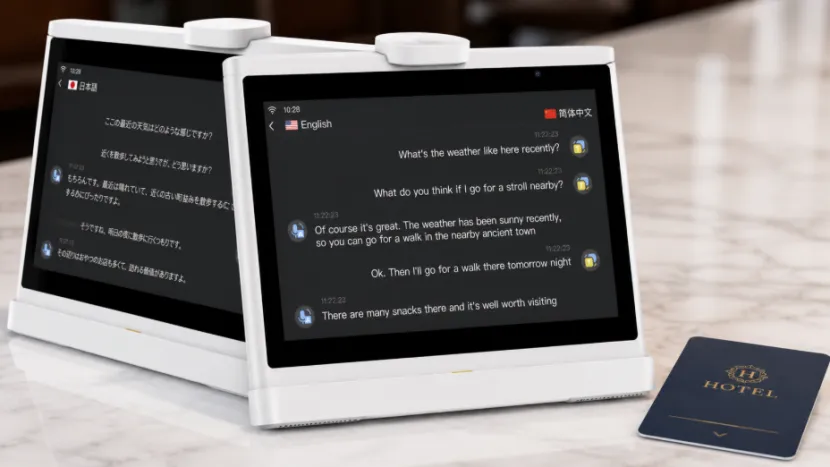
A two-way translation screen gives each side its own display. Staff can read one side, guests can read the other. This AI translation display feels more natural because both people stay in the conversation. No awkward passing of a phone. No leaning over the counter.
Desktop Placement Feels More Professional
A desktop AI translator sits like a normal hotel translation device beside the POS terminal or card reader. It belongs at the desk. For a hotel lobby, that matters. A clean counter with a fixed business reception translator looks more prepared than a staff member searching for an app during check-in rush.
Real-Time Translation Keeps the Conversation Moving
A real-time translation device supports face-to-face translation without long pauses. Guests can ask, “Can I leave my luggage?” or “Is parking free?” and staff can answer faster. The conversation does not become perfect, but it becomes workable. In hotel service, that is often enough.
How Can a Hotel Front Desk Translator Reduce Guest Complaints?
Complaints usually do not start with big problems. They start when a guest feels nobody explained the rule. A hotel front desk translator gives staff a clearer record of what was said on screen.
It Helps Explain Deposits and Extra Charges Clearly
Deposit explanation is one of the biggest front desk pain points. Pre-authorization, tourist tax, late check-out fee, breakfast add-on, and room upgrade price should be shown clearly. When guests can read the translated text, hotel guest complaints linked to “you did not tell me” may fall.
It Makes Breakfast and Check-Out Details Easier to Confirm
Breakfast time translation and check-out time translation sound simple, but they are high-frequency details. “Breakfast is from 7:00 to 10:00.” “Check-out is before 12:00.” “Luggage storage is available after check-out.” These short lines can save long arguments the next morning.
It Gives Front Desk Staff More Confidence
A good AI translator for hotel reception does not replace good service. It gives staff a backup. New staff, night shift staff, and seasonal workers can still offer multilingual hotel service with less stress. You can almost see the shoulders relax when the device handles the hard sentence.
What Features Should Hotels Check Before Buying a Front Desk Translation Device?
Before buying a front desk translation device, hotels should look at more than language count. The device should fit the counter, the lobby noise level, and the way guests actually speak.
Dual Screens and Touch Display Size
A 10.1-inch dual-screen translator gives guests enough space to read full sentences. YIAISIGN’s device uses 2×10-inch IPS HD touchscreens and FHD touch displays, which suit a fixed reception desk better than a small handheld screen.
Microphone Pickup and Noise Handling
Hotel lobbies are not quiet. There are suitcases, children, background music, and people asking for taxis. Dual microphones help capture voices more clearly. For front desk use, microphone noise handling is not a small feature. It affects every conversation.
Language Coverage and WiFi Connection
Hotels should check whether the device covers their main guest markets. With 30+ languages and WiFi translation, a real-time translation device can support common hotel reception translation needs for international hotel guests.
Speaker, Camera, and Certification
Practical details matter too. The YIAISIGN device includes 1080P HD cameras, a 2W speaker, DC 12V/2A power, and CE FCC ROHS certification. For procurement teams, these points help judge whether the device is fit for daily commercial use.
Where Does YIAISIGN Fit Hotel Reception Needs?
The YIAISIGN Table Display AI Double Screen Translator fits hotel counters because it was built for desktop, face-to-face multilingual communication. It combines AI assistant features, dual microphones, FHD touch displays, WiFi, and clear two-person screen viewing.
YIAISIGN is a professional digital display screen manufacturer with over 15 years of experience in smart display products. Its wider product range includes digital frames, Android all-in-one machines, digital signage, advertising machines, and portable monitors.
For hotels, this background matters because the device is not just a language gadget. It is part of a display hardware ecosystem made for business spaces, counters, and customer interaction.
Can Dual-Screen AI Translators Replace Human Interpreters in Hotels?
Dual-screen AI translators work best for daily service communication. They are not meant to handle every possible situation.
They Are Best for Daily Hotel Service Communication
A hotel front desk translator is useful for check-in, check-out, breakfast, directions, parking, room policy, payment, and luggage storage. These are repeated questions. A device can handle them quickly and clearly.
Complex Legal or Medical Issues Still Need Human Support
Dual-screen AI translators have become an essential tool, and for busy front desks, YIAISIGN solutions provide a shared screen communication platform for staff and guests, enabling both parties to directly communicate, confirm, and get work done without turning every small problem into a long delay.
FAQ
Q1: Why Do Hotels Need a Hotel Front Desk Translator?
A: A hotel front desk translator helps with hotel guest communication around check-in, deposits, breakfast, check-out, room rules, and common guest questions.
Q2: How Does a Dual-Screen AI Translator Help Hotel Reception Staff?
A: A dual-screen AI translator lets hotel reception staff and guests read translated text at the same time, which reduces repeated explanations.
Q3: Can YIAISIGN Table Display AI Double Screen Translator Be Used Beyond Hotels?
A: Yes. YIAISIGN Table Display AI Double Screen Translator can also work as a customer service translation device for airports, showrooms, tourism centers, service counters, and business reception areas.