Different from general display devices, customized commercial display involves complex space adaptation, technical specification matching and visual experience optimization. In order to ensure that your project can be accurately landed, this guide has four dimensions to comb out an efficient ordering path for you.
1. Qualitative Definition of Core Requirements: Clarify “Why” and “Where to Use”
The first step of customization is not to touch the hardware, but to define the essential requirements of the scene. The purchasing logic of commercial displays is different from that of consumer electronics. The core lies in the matching of the usage scenario.
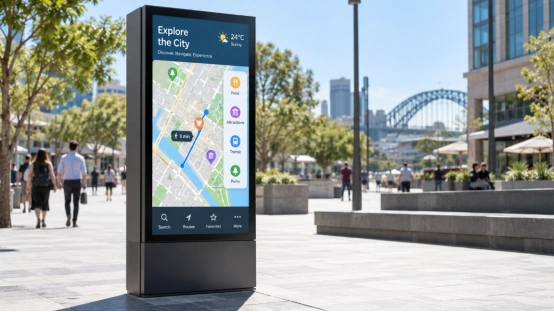
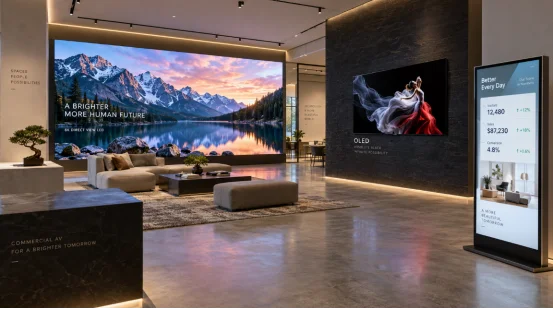
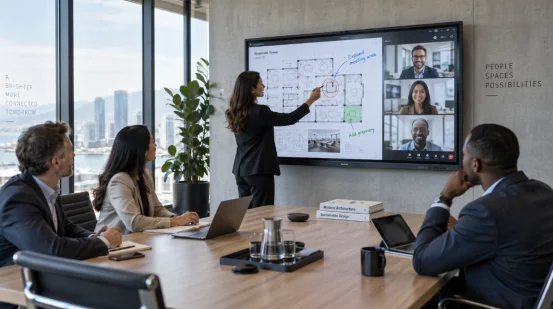
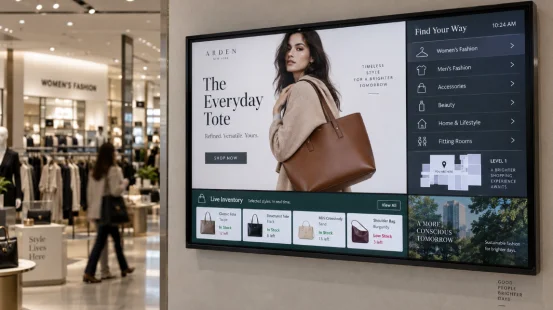
Firstly, you need to clarify the core mission of the equipment. Is it used for lobby information distribution (such as airport, office lobby), for immersive art presentation (such as art museum, exhibition hall), or for high-frequency interaction meeting collaboration? Different missions determine the brightness threshold, contrast requirements, and whether a touch module is needed.
The physical limit of the second, the space environment is the key to determine custom feasibility, you must carry on the accurate measurement of installation area, including the bearing capacity of metope, reserved access channel space and environment light intensity and scope of stadia. Professional customized ordering should start with a detailed site survey data, which can effectively avoid visual disasters caused by size deviations or environmental light reflection.
2. Key Technology Selection: Balance Performance and Business Value
After defining the scene, enter the essential stage of hardware selection. The technology selection of commercial display should avoid blindly pursuing parameter stacking, and should follow the principle of sufficient and durable. In the selection of the display module, pixel spacing is the primary indicator to determine the degree of fineness of the screen, which needs to be set according to the minimum viewing distance of the audience, too small spacing will increase unnecessary procurement costs, brightness and contrast need to be dynamically adjusted according to the interference degree of ambient light, and high brightness panels need to be configured in bright indoor environments to prevent the screen from graying. Affect the accuracy of business information.
In addition, the compatibility and scalability of the system are the foundation for the long-term operation of commercial displays. When ordering, you must confirm whether the screen supports multiple formats of signal input (such as HDMI, DP, SDI, etc.), and focus on the supporting playback control system. An excellent commercial display is not only a display terminal, but also a node of the Internet of things, supporting remote content scheduling, real-time status monitoring and intelligent energy-saving management. If your project involves multi-screen linkage or irregularly shaped assembly, you also need to focus on the synchronization performance of the controller and edge fusion technology.
3. Environmental Adaptation and Structural Design: The Essence of Customization
The core competitiveness of customization lies in the perfect integration of hardware and space environment, which requires the purchaser to deeply involve in the environment adaptation plan with the supplier at the ordering stage.
In terms of installation form, the structural design should give priority to non-sensuous integration. No matter embedded installation, wall hanging installation or lifting, heat dissipation space must be reserved and the integration of appearance and architectural decoration must be ensured. For special modeling requirements such as arc and curved surface, the joint compensation technology of the module and the fine customization standard of structural parts should be specified when ordering.
In addition, the electrical and power demand is often overlooked, is usually accompanied by a custom display large power consumption, you need to coordinate in advance room power distribution, cable hidden path and anti interference shielding measures.
4. Full Life Cycle Management: Contracts and After-sales Guarantee
The purchase of commercial displays should not be a one-time transaction, but a long-term cooperation process. Due to the non-standardized nature of custom screens, the after-sale assurance is much more complex than that of generic products.
The ordering contract should focus on stipulating the spare parts mechanism. It is difficult to find the same batch of original modules, control cards and power supplies of customized products in the later stage, so it is necessary to ask the supplier to provide at least 3%-5% of the same batch of original factory spare parts.
Finally, software authorization and update agreements are also important. Commercial display screens are usually bound with specific broadcast control software. The contract shall specify the charging policy for subsequent upgrades and the support cycle of the software system to avoid early hardware obsolescence due to system supply failure. Through detailed contract terms, the post-sales risks can be pre-positioned, which is the key to maximizing the commercial value of the project.
Ordering Strategy Checklist
- Quantification of Requirements: Quantify the survey data, viewing distance requirements, and brightness environment as the core of the bidding/quotations.
- Compatibility Verification: Require the manufacturer to provide a system integration solution description to ensure seamless integration with the existing network environment.
- Disaster Recovery Reserve: Adhere to the “module + control card” spare parts procurement policy to ensure the fault self-healing capability during the entire duration.
- Professional Consultation: If you need in-depth customized suggestions and hardware solutions for specific commercial scenarios, you can refer to the professional support provided by industry experts and visit YIAISIGN for more business display solutions and industry application cases.
The ordering process of custom commercial display screens is essentially a re-shaping of spatial value. By use the scene of accurate control, the rational choice of technical standards and rigorous constraints of after-sale guarantee, you will be able to create both have visual impact, and has the value of long-term operation digital display platform.