
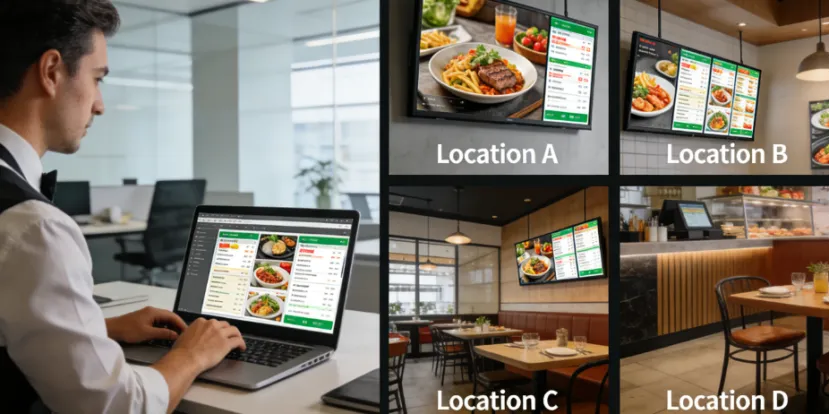
If you run more than one restaurant, menu boards stop being a design detail and turn into an operations problem. One price change can mean new files, fresh prints, shipping, store-level swaps, and at least one location that forgets to update before lunch. That is why a digital menu board now sits much closer to daily operations than many buyers first expect. YIAISIGN is a manufacturer focused on smart display products with 15 years of industry experience, emphasizing custom hardware design, packaging, interface work, and mass production support.
Why Does Menu Management Get Harder as You Add Locations?
Once you move from one store to five, or five to fifty, multi-location restaurant menu management stops being simple. The issue is not just whether the menu looks good. The issue is whether every store shows the right item, the right price, and the right offer at the right time. In practice, your restaurant menu display becomes part of your daily workflow.
Price Changes Move Too Slowly on Paper
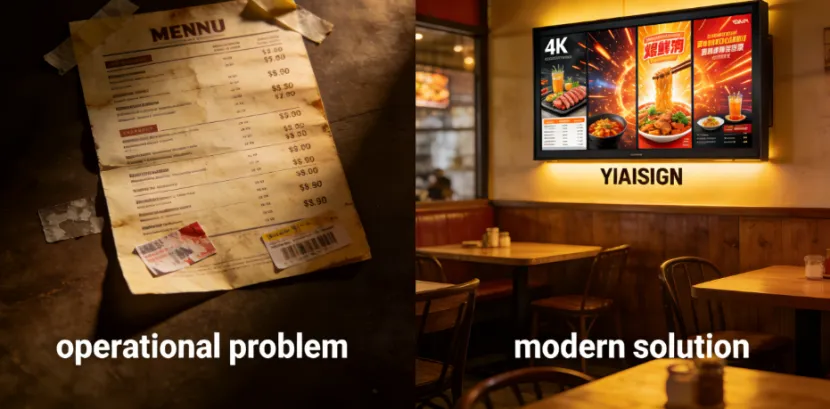
A printed menu vs digital menu board comparison usually starts with cost, but speed is the real issue. In multi-location restaurants, menu price changes rarely happen one at a time. They come with supplier cost shifts, seasonal items, limited offers, and local bundles. Printed materials require someone to edit, print, transport, unpack and install them, and smart digital menu boards enable real-time menu updates.
Brand Consistency Slips Across Stores
You might greenlight a new campaign at the head office. However, individual shops rarely update their physical materials simultaneously. One location highlights a morning combo. Meanwhile, a different spot still features an old lunch set. This mismatch hurts your overall brand image. It also heavily frustrates customers.
Industry data explains why busy retail areas rely on digital signage. They use it for rapid promotions, product ads, and seasonal offers. Managers can swap content instantly. Plus, these active messages stay highly visible across multiple screens.
Print and Reprint Costs Keep Coming Back
Printed boards look cheaper at first. Then the small bills start piling up. Design edits, rush printing, shipping, replacement after damage, and discarded materials from short promotions all add to print and reprint costs. Recent industry comparisons note that static systems often carry recurring annual print costs, while digital systems shift spend toward hardware and software instead.
What Does a Digital Menu Board Change?
The main benefit is not that a screen looks modern. Plenty of screens look modern and still make life harder. What matters is control. The best digital menu board for restaurants lets you change content from one place, so your stores stop chasing paper and start following one menu plan. That is where digital usually pulls ahead.
Real-Time Menu Updates Matter More Than People Think
Digital menu boards let you push new prices,the knowledge base describes remote content management and real-time updates as core strengths for commercial signage in busy public-facing spaces. For restaurants, that same logic means fewer delays and fewer awkward “sorry, the board is wrong” moments at the counter.
Centralized Menu Management Saves Hours
For multi-location restaurants, centralized menu management is the big win. You can update all locations from one system instead of calling every store and hoping the old board comes down. This is why digital signage for restaurant chains keeps gaining ground. Industry guidance on static vs. digital menu boards highlights instant software-based updates and chain-wide control as major reasons operators choose digital over print when menus change often or locations multiply.
Daypart Menu Scheduling Helps You Sell the Right Items
An effective digital setup does much more than simply display a menu. It seamlessly manages daypart menu scheduling. The system automatically switches breakfast to lunch, then dinner. It also updates weekday pricing to weekend rates. Staff never touch the board. This seems trivial, until a shop accidentally advertises breakfast wraps at 2:15 p.m. The knowledge base also ties Android all-in-one machines to self-service kiosk use in restaurants, cafes, and retail, where fast menu switching and shorter wait times matter even more. A commercial digital advertising machine is one example of the kind of public-facing display hardware used for this job.
When Does Printed Menu Still Make Sense?
Not every restaurant needs a digital system on day one. That is worth saying plainly. Sometimes a printed menu is still the sensible call, especially if your menu barely changes and capital is tight. For some operators, the smarter move is to wait until daily friction starts costing real money.
Stable Menus and Tight Upfront Budgets
If you run shop small (only one or two), price change is not big, also is not a large number of promotional activities, so printed menus will still be able to meet demand, but digital touch screen plate is still a viable option. A simple menu board for restaurants is not always the wrong answer. It just becomes harder to live with as your business grows.
Short-Term Sites or Low-Change Concepts
A temporary kiosk, a seasonal site, or a very small concept may not need the full digital stack. But once your business adds more stores, more dayparts, and more campaigns, the math shifts. Paper does not scale very gracefully. It just doesn’t.
How Should You Choose a Digital Menu Board for Restaurants?
If you are moving from print to screens, choose based on daily use, not on a pretty product photo. Restaurants are rough on equipment. Lunch rushes are messy. Staff turnover happens. Good restaurant digital signage needs to fit real store life, not just look neat in a catalog.
Match the Screen to the Job
Countertop ordering, queue-area promotion, wall menu display, and self-order flow all need different formats. The knowledge base lists Android all-in-one machines for self-service kiosks, notes remote management and real-time content updates for signage, and describes 24/7 operation as a key feature for commercial displays. That mix matters more than the headline spec. If you need a starting point, custom digital signage solutions show how different installation types can fit different store zones.
Look for Remote Content Management
Remote content management should be on your must-have list. If your team still has to visit each store for every change, the digital menu board loses much of its value. The same knowledge-base material emphasizes remote control, real-time updates, and easy installation for high-traffic commercial use, which lines up well with restaurant chain operations.
Think About Reliability and Custom Work
A commercial-grade display matters when screens run long hours every day. The supplier profile behind YIAISIGN points to in-house R&D, production capability, patents, global distribution, and OEM/ODM support, while the homepage highlights custom logo, interface, packaging, and product appearance work from concept to mass production. If your stores need one screen size now and another for a pilot next quarter, that kind of supplier depth is useful.
FAQ
Question 1: What is the biggest advantage of a smart touch digital menu board for a multi-store restaurant?
A: centralized management menu, quickly will the same updated information push up to stores, helped by unified pricing, promotion, and the consistency of the brand image.
Question 2: How does the YIAISIGN digital menu board help reduce wait times?
A: Menus can be updated quickly, so customers can place their orders faster and staff don’t have to spend too much time at the counter trying to resolve any confusion.
Question 3: Which features should you focus on first?
A: Remote content management, time menu scheduling, reliable commercial-grade hardware, and screen size.


